A New Beginning at the Hill Dickinson Stadium
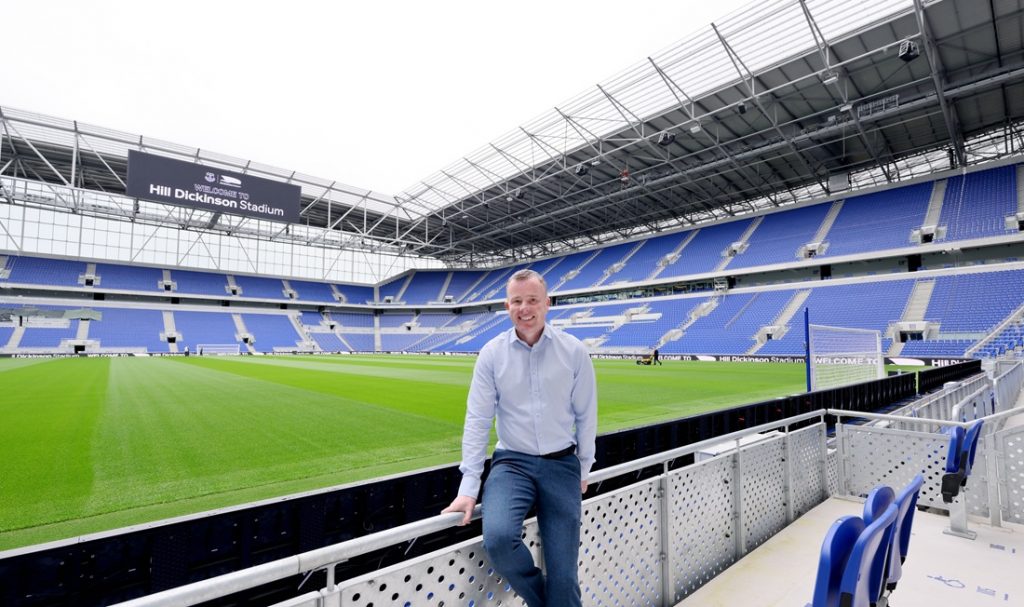
As Everton starts the next chapter in their long and storied history, Angus Kinnear, the newly appointed CEO, outlines his expectations as the club transitions to its new stadium.
After eight years at Leeds United, Angus Kinnear now finds himself in the Northwest at the helm of Everton as they make the historic move to a new stadium this season brimming full of opportunity and hope.
And for Kinnear, who has experience of stadium moves during his time at Arsenal as Commercial Director and West Ham as Managing Director, this is another opportunity to bring his skills to a club that is taking a giant leap with its ambitious stadium project.
Everton will begin the season in their new home at the end of August, a week after they travel to face Kinnear’s former club, Leeds United at Elland Road. The newly promoted club has lofty ambitions for their own historic stadium, but the scale of the opportunity at Everton was hard to resist for Kinnear.
Despite Everton’s recent problems with sanctions for Premier League financial regulation breaches and a change in ownership, which saw The Friedkin Group complete its takeover late last year, in turn ending the turbulent tenure of the former owner, the club has been able to progress with the work on its new stadium which will open on time and on budget.
Speaking to fcbusiness in the high-spec media theatre at the spectacular new stadium, Kinnear explained why the stability offered by the club’s new ownership, who also own Serie A side, AS Roma, was a key factor in him accepting the opportunity to move to Everton.
“What I saw with The Friedkin Group, was the emergence of really strong foundations and a principled owner that has a long-term vision for the club,” he explained.
“That combination of ownership, fanbase and the potential of the new stadium made it the most attractive proposition in European football for a Chief Executive.”
Kinnear was unfazed by the club’s recent challenges and believes they are now in a strong position to take advantage of the opportunities that lie ahead. “Anything worth achieving comes with its challenges,” he stressed.
“The Friedkin Group already have experience in football owning [AS] Roma, so they’re not new to this sport. When they shared their ambitions with me, and what they believed they could achieve here, it made me feel that the potential was pretty much limitless.”
Everton’s new stadium – Hill Dickinson Stadium as it is formally known, after signing a long-term naming rights deal with the international law firm that is headquartered in Liverpool – shows how they intend to leverage the revenue generating potential it offers.
“People talk about how important TV revenue is in the makeup of a Premier League football club; and it is, but over the last 10 years we’ve seen how the successful clubs are using their stadium revenues as a differentiator between them and the competition.
“The step change in revenue that this stadium will create will be one of the ways Everton jumps, in the medium-term, from being a lower mid-table team, to one that should be finishing comfortably in the top half of the table and looking upwards.
“What this stadium will enable us to do is to win more football matches. That’s at the heart of what we want to do. I look at it as a means to making the team on the pitch stronger and our supporters proud, by winning more games.”
Leadership and Stadium Transition Strategy
The Friedkin Group sought a Chief Executive with experience of previous stadium moves and using it as a catalyst for change both commercially and sporting. At Leeds United, Kinnear oversaw the club’s rise back to the Premier League after 16 seasons away from the top-flight and despite relegation in 2023, they returned as champions of the EFL Championship last season. Whilst at Arsenal he was there when they moved from their former home at Highbury to the Emirates and at West Ham from Upton Park to the Olympic Stadium.
Everton’s new stadium is certainly on a scale and ambition that is far removed from what was possible around a mile and a half away at Goodison Park. One of the oldest stadiums in the UK, Goodison is beloved by football fans but its operational and commercial potential was a limiting factor for the future growth of Everton.
The four-year stadium build on the former Bramley-Moore Dock, on the banks of the River Mersey, was overseen by Colin Chong, who became interim CEO after the departure of Denise Barrett-Baxendale in 2023. The complexity of the site provided its challenges, not least the movement of 480,000 cubic metres of sand from the seabed to fill the dock before it could be built on.
Now complete, the stadium will have an official capacity of 52,769, around 13,000 more than Goodison Park, will mark a huge step up in operations for Everton.
“I’ve had good experience, not just operationally, of how you deliver a new stadium, but how you use a stadium as a catalyst for change across all elements of the club,” Kinnear explained.
“What you realise when you walk through this stadium and you see the quality and the benchmark that we’ve set, this is a stadium befitting of Champions League football.
“It’s helped attract new staff who can add to the talent of our existing team, and it’s been helpful for energising and attracting new sponsors. The naming rights partnership that we announced is significant, but we also have more founding stadium partners to come, and it will completely revolutionise our partnership business.”
Commercial Partnerships and Stadium Activation
The move is being used as a way for partners to reframe how they see Everton, with existing partners looking at how they can activate the stadium better, as Kinnear explains: “What we’re trying to do around our partnership strategy is use the move as a way for partners to reframe how they see Everton Football Club.
“We’ve had some fantastic partners historically, but as much as everybody has huge amounts of affection for Goodison Park, from a partnership perspective, it was a difficult stadium to activate.
“We’ve been able to go out with a new narrative to partners. It’s important to a partner that they’re collaborating and aligning with an organisation which shares the same values, and The Friedkin Group have a reputation for being long-term investors who are highly professional and have high levels of integrity.”
Commercially, the new stadium provides Everton with a hugely valuable asset that stretches beyond football, something Goodison Park could never do. And key to the stadium’s long-term success is its design as a multi-use venue, which will see music and other sporting events hosted throughout the year bringing more value to its sponsors. And that will be much needed as next year will see the self-imposed Premier League wide ban on front-of-shirt gaming and gambling sponsorship.
“We’ve got one more year of Stake.com on the front of our shirts before the Premier League’s voluntary ban comes in. It was something that all the clubs ultimately supported. But it reinforces the need to have stronger, more compelling narratives for the club.
“We’re going to need to create deeper connections with partners and have more differentiated and creative ways to activate. What’s happening at Everton uniquely places us in a position to be able to transition with confidence to a non-betting or gaming front-of-shirt sponsor.
“Partners want to see some level of ambition and a change of direction on the pitch,” Kinnear stressed, as we discussed the club’s on-field ambitions. He cites the recent success of Crystal Palace who won the FA Cup, and Newcastle United’s Carabao Cup win as examples of club’s matching their ambitions with success.
“We’ve also seen Aston Villa and Nottingham Forest make runs into Europe, and these are all things which should be well within the ambition set of Everton,” he says.
On-Pitch Success and Stadium’s Role
One of the main challenges for clubs building and moving to a new stadium is ensuring any transition doesn’t affect what happens on the pitch. Kinnear is confident that Everton hasn’t and will not be affected by the move.
“The primary objective of all of this, is it needs to help us win more football matches, and that’s never been forgotten. I do think that that when clubs make stadium moves they can sometimes get distracted by the excitement around the revenue that it’s going to generate and forget that the core of it is what happens on the pitch.”
“Here, we’ve made sure that our football operations team has always had an input into the design, whether that’s the changing rooms, the media centre or the construct of the pitch – so from a technical perspective, we feel confident.”
Kinnear praised the investment and support of The Friedkin Group since they took over the club, which has minimised any impact on development plans for the squad as a result of building the stadium.
“Sometimes when stadium transitions have not gone according to plan, playing funds get diverted into over-running construction costs. A key pillar of making this successful is we’ve been able to ringfence that investment to make sure the team can grow in line with the stadium.
“We’re in the middle of the transfer market at the moment, and I know that often people say footballers only care about money, but it’s not solely the case; they care about the heart of the club, the direction of the club and the ambition of the club matching their own career goals.
“There’s no better physical manifestation of that ambition than a stadium of this quality, and it’s something that we are impressing on a lot of our targets across this window. And that will make the squad better and stronger.”
Fan Engagement and Matchday Experience
A crucial factor will be how the fans take to their new home. Goodison Park was famed for its atmosphere, the tightness of the stands and the proximity to the pitch. These are all vital elements they have been keen to recreate at Hill Dickinson Stadium.
“From the perspective of the atmosphere, people say when you move stadium, you’re affected and it’s like playing at an away ground for the first game. I’ve no doubts it won’t feel like that at all here.
“We’ve already seen from the test events, this stadium has the potential to be Goodison on steroids, and that’s what we want to create.”
Everton have worked with its supporters and fan groups in all steps of the build and the new stadium will be branded to feel like home and create a unique matchday experience. A key element of the stadium is the south stand, which is pitched at 34.99 degrees – the steepest it can be within the 35-degree limit stipulated in modern building regulations – and includes rail seating (safe-standing) barriers, which were introduced, in part, through consultation with fans.
“You must put the supporters at the heart of the transition. What really pleased me when I arrived, was that supporters have been at the heart of this project right from the start. “The stadium was designed on principles that were chosen by supporters, and that’s why we’re going to have one of the few new stadiums in the Premier League where I think the atmosphere will be better than the old.
“It’s always challenging when clubs have moved from a stadium which was tight to the pitch, and they’ve increased capacity – sometimes the atmosphere has dissipated because of that. I don’t think that’s going to happen here.
“We need to bring the wonderful Goodison atmosphere, supercharge it and move it into this stadium. If supporters feel that we’re doing all those things right and giving them a much better matchday experience, but with the same Goodison magic, then we will have achieved the most important part of the transition.”
Premium Experiences and Affordable Access
Hill Dickinson Stadium has been designed as a multi-use venue, which offers a wide range of uses and a variety of premium experiences with segmented options. Going from around 1000 premium spaces at Goodison, the new stadium will offer over 5,500 covers, greatly enhancing its offerings.
From high-end dining to street food and traditional pubs, the stadium offers a comprehensive range of services for fans and non-matchday attendees. Taking inspiration from a wide array of venues, the club has introduced a players’ tunnel viewing experience and the first of its kind in the UK ‘loge’ style premium seating enclosures, with reclining cinema style seats and private TV monitors for highlights and replays, in partnership with Seat Unique.
In the West Stand they have created Village Street, which will feature a large social bar, a sports bar and two traditional pubs – The Queen’s Head and The Prince Rupert. Outside the stadium, there’s a 17,000-capacity Fan Plaza, which will come alive with pre-and-post-match entertainment and cultural events all year round. This range of premium experiences will help the club grow its matchday revenues, which they say will help keep general admission ticket prices affordable.
“This is the ‘People’s Club’, and we want to make sure that no one’s priced out of this great venue,” said Kinnear.
“We have great price points for general admission and for children. I know supporters are often concerned about the gentrification of football stadiums, but the increased revenues from these areas will help us to keep the ticket pricing in the rest of the stadium low and affordable.”
And whilst there’s been an emphasis on the premium experience, a lot of work has also gone into improving the general fan offering.
“We’ve a good understanding of what the general admission supporter wants and what they want from their matchday experience,” he continued. “Fans will experience really generous concourses, which are designed for them to actually spend some time in, which are well-lit and, in the south-facing bar, we have floor to ceiling windows with spectacular views of the city and the royal blue Mersey, so we have a really good chance to increase the dwell time, both before and after matches, both on the concourses and in the Fan Plaza.”
These areas will undoubtably be enjoyed by fans, but Kinnear expressed that the club would go through a process of incremental improvement as the season progresses as they learn more about the way they function and are used by fans.
“We don’t really use the term hospitality anymore. This is about creating experiences where the match is still right at the heart of what fans want to do. These are really well thought through areas, but it will evolve, and the mindset we want from our team is ‘how do we get better each and every game?’.
“By next season there’ll be lot more improvement. And that’s what I’ve learned from stadium moves historically, it’s not a flick a switch moment, it’s an evolution in terms of making it work and then optimising it for everybody.”
Operational Changes and Staff Development
Operationally, the new stadium represents a huge step up from Goodison Park. The matchday workforce will more than double across all areas with hundreds more people employed, a major jobs and training boost for the local area.
“It’s a huge change and a huge step up, for us,” Kinnear continued. “We had a really dedicated, but relatively small team who delivered Goodison.
“We’re going to employ hundreds more people, both from a stewarding and catering perspective than we did. This will provide a great boost for employment in the area. There’s a lot of training that’s gone into getting the staff to the standard to operate the stadium expertly and safely.
“At every level, I’ve seen how people are stepping up. We want the players to come in and say this is a sign of the ambition of this club.
“It’s been a full club effort, and I think a project to this scale touches everybody here, and at the training ground. The performance and fitness coaches have thought about how the warm-up area is going to work. The tactical analyst team have looked at how the video systems in the changing rooms will allow them to feed in their tactical data in real-time during games.
“Everybody is seeing it as a really positive experience. It’s not without its challenges, but we’ve got a really passionate team of staff here and I know we can rely on that passion and commitment to make sure the opening works.”
With a programme of branding the stadium and making it feel like home for Everton fans ahead of the new season, it’s clear it’s been designed to the highest international football classifications, but so it can also host other events such as rock and pop concerts with ease. Additionally, the Fan Plaza will be a game changer for both matchday and a non-matchday events.
“We have the Fan Plaza that can hold up to 17,000 people, which will see smaller concerts and festivals held there – in addition to the big stadium concerts we can deliver. Then we have all our lounges and premium areas, which are going to help us become one of Liverpool’s most exciting meeting and events venues.
“These spaces are incredibly flexible and can cater for anything from big conferences to small meetings and because we’re a short walk from the city centre it makes it more accessible and gives us a real competitive advantage.
“If you look at all the benchmarks that a stadium must have, whether it’s environmental sustainability, whether it’s revenue-generating capability, hospitality and premium areas, its GA, its non-matchday programmes, or its ability to be a catalyst for regeneration, we are right at the top of the pile.”
For Kinnear and the club’s owners and staff, the hard work is yet to come, but 2025/26 will be an exciting season of transition both on and off the pitch.
Whilst they are optimistic about the prospect, they remain cautious that there is still a lot to be done, not only at Hill Dickinson Stadium, but back at Goodison Park which, in a bold move, will become the exclusive home of Everton Women, a decision that underlines their commitment to supporting the growth of the women’s game, remaining at the heart of the community and preserving its heritage.
Images: Tony McArdle / Everton FC