Modern Finance In Professional Sport Starts With Connected Data
What can sports clubs learn from the finance transformations at Millwall, Hearts and Aberdeen? Eureka Solutions explores how connected systems, automation and responsible AI can help small finance teams deliver greater insight.

A busy stadium does not necessarily mean a well-resourced finance department. Behind the ticket sales, sponsorship agreements and matchday activity, a small team may be responsible for everything from supplier payments to cash forecasting and board reporting.
The challenge is bringing that information together quickly enough to make it useful.
Ticketing, hospitality, retail, CRM and payroll platforms each hold part of the picture. When finance has to collect exports and reconcile spreadsheets before answering a question, valuable time goes into preparing information rather than understanding it.
AI brings new possibilities for analysing performance and supporting decisions. However, clubs need reliable data and clear financial controls to make those possibilities practical.
Choosing an ERP system that fits the club
For larger sports clubs, choosing an ERP system means looking beyond basic accounting. The platform needs to support the organisation’s reporting requirements, financial controls, commercial activities and plans for growth.
Oracle NetSuite is one option worth considering where clubs need broader ERP functionality, detailed reporting and scope to manage multiple entities. Its OneWorld capabilities support financial consolidation across subsidiaries, which can be relevant to organisations with several legal entities or activities. The right configuration and modules depend on the club’s requirements.
Eureka Solutions has worked with clubs including Millwall, Heart of Midlothian and Aberdeen FC on NetSuite implementations. Their experiences demonstrate why selection should start with the problems finance needs to solve.
At Aberdeen FC, replacing legacy systems created an opportunity to improve purchasing, approvals, asset management and reporting. Digital purchase orders replaced paper-based processes, while more current financial information gave department heads better visibility of performance. The club’s published case study also identifies future Salesforce integration as part of its plans for a more connected environment.
The appropriate platform will vary between organisations. Eureka’s work with Caledonia Gladiators, for example, involves iplicit financial software alongside Besyncly integration, illustrating a different approach to modernising sports finance.
A useful starting point is to ask prospective partners to demonstrate the club’s own reporting scenarios, approval processes and integration requirements.
Connecting ticketing and ERP data
A finance system becomes more useful when it receives reliable information from the specialist platforms around it.
For ticketing and ERP integration, clubs should assess how a service handles the full financial process. That includes mapping transactions to the correct accounts, retaining relevant event information, accounting for refunds and fees, and reconciling totals.
Clubs should also establish who monitors failures, how corrections are made and who supports the connection when either system changes. These details determine whether an integration reduces manual work or creates another process for finance to manage.
Besyncly, Eureka Solutions’ integration platform provides a managed approach to connecting business systems, with specialists supporting discovery, implementation and ongoing operation. Its published connector range includes ticketing, ERP, CRM and ecommerce platforms, although each proposed connection needs to be assessed against the systems and data involved.
Millwall’s published case study offers a practical example of the opportunity. It identifies a planned Ticketmaster integration through Besyncly to automate ticketing transaction transfers into NetSuite and provide more detailed information than manual journals allow.
That detail matters when finance needs to understand how individual fixtures, events or commercial activities contribute to performance.
Giving finance time back
The benefits of modernisation can be measured in the time available to the team.
Following its NetSuite implementation with Eureka Solutions, Heart of Midlothian reduced its month-end close from 12 working days to six. Its reporting also became more detailed, supporting analysis of activities including European competitions, grant-funded projects and squad-level costs.
Millwall’s published results include a 75% improvement in management reporting turnaround and a 70% reduction in audit preparation time.
These are results from improvements to finance systems and processes. They show the value of establishing a stronger foundation before extending the use of AI.
For leadership teams, the practical benefit is receiving information while there is still time to act on it.
Making AI useful and accountable
With connected, well-structured data, clubs can identify focused opportunities for AI. A starting point might be drafting commentary on budget variances, flagging unusual transactions for review or exploring how attendance and renewal assumptions could affect cash forecasts.
Each use case needs a clear purpose, an accountable owner and a way to check accuracy. Sensitive information should remain within approved tools, while material financial decisions and postings retain appropriate human review.
Clubs should also distinguish between established automation, available AI functionality and future product developments. Feature availability will depend on the chosen platform, licensing and configuration.
Starting with one measurable problem gives finance teams a practical way to assess value before expanding adoption.
Want to assess your club’s readiness? Download AI in Sports Finance: What Professional Sports Organisations Need to Know, our practical guide to data foundations, governance, potential use cases and AI readiness.
Download the sports finance guide
See the framework in action
Eureka Solutions’ upcoming webinar, Modern Finance in Professional Sport: Data, Automation and AI, will explore these topics through practical examples and experience working with sporting organisations.
Taking place on Tuesday 27 October 2026 at 2pm, the session will cover connected data, cloud ERP, automation and AI, alongside a demonstration of a sports finance dashboard bringing key financial measures together.
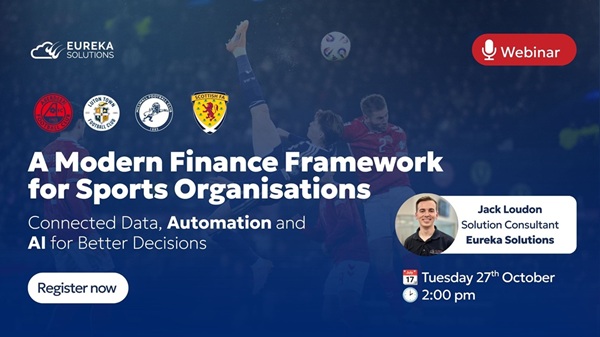
Whether the priority is replacing a legacy system or improving existing reporting, join us for practical ideas to help your finance team plan its next step.