Soccer Fandom In North America Climbs To More Than 136M
A new Nielsen report highlights double-digit growth across the USA, Canada and Mexico as interest builds towards the tournament.

Soccer fandom in North America has grown to more than 136 million people, according to new consumer research from Nielsen, with the sport’s following across the continent rising 10.9% over the past five years.
The findings, published in Nielsen’s new Soccer Fandom report, underline the accelerating momentum behind the game in the USA, Canada and Mexico as the region prepares to host the FIFA World Cup 2026™.
The report examines audience growth, engagement, content consumption and fan behaviour, using trended data to assess the current soccer landscape across the three host nations.
“Nielsen’s new report illustrates the profound and measurable surge in popularity of soccer in North America, reinforcing the decision to host the FIFA World Cup 2026™ across the continent,” said a FIFA spokesperson.
“The research findings also underscore the success of the efforts that have taken place to grow the game and expand the sport’s global reach.”
North America’s soccer audience continues to expand
Nielsen’s research shows that soccer fandom across North America increased by 10.9% between May 2020 and May 2025, supported by rising broadcast audiences and growing interest in major international competitions.
The USA now has the fourth-largest soccer fanbase in the world, with 62.5m fans, while 64% of soccer fans across North America say they expect their interest in the sport to continue growing.
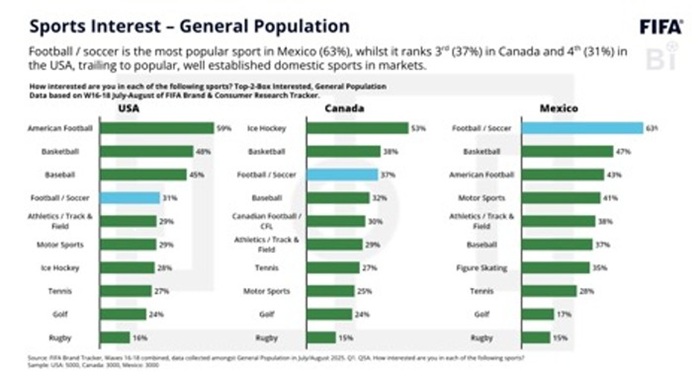
Mexico remains the region’s strongest soccer market, where the sport is the most popular among fans at 63%. The average Mexican soccer fan has followed the sport for around 14 years.
In Canada and the USA, soccer faces stronger competition from established domestic sports. It ranks third in Canada, with 37% of fans, and fourth in the USA, with 31%, behind sports including ice hockey and American football.
Around a quarter of soccer fans in North America became fans within the past five years. The report also found that 68% of fans said their interest had increased over the past three years, coinciding with the build-up to the FIFA World Cup 2026.
Younger, more affluent and increasingly diverse fanbase
The report identifies distinctive demographic trends among soccer fans in North America, particularly in the USA, where fans are younger and more affluent than the general population. The average US soccer fan is 33 years old, while 76% are Millennials or Gen Z.
Female engagement is also higher in North America than in Europe, with women making up 43% of soccer fans in the region compared with 36% in Europe.
Across North America, fans said soccer plays a significant or extremely significant role in their lives, including through personal enjoyment (29%), social connection and community (14%), family bonding and tradition (12%) and physical fitness and health benefits (11%).
TV, streaming and social media drive engagement
North American soccer fans follow similar media engagement patterns to fans in Europe, with 72% watching the sport through TV or streaming platforms. Social media is also a major channel for engagement, used by 47% of fans.
In Mexico, fans are more likely to watch live match broadcasts, with 51% saying they typically consume matches in that format. Nielsen noted that Mexican fans often watch at home with family and friends, reflecting the social roots of their connection to the sport.
Canadian fans, meanwhile, show a stronger preference for short-form content, with 33% favouring highlights and social media clips.
Major tournaments point to wider economic impact
The report also highlights the potential economic impact of major FIFA events in North America. Nielsen cited the FIFA Club World Cup, held from June 14 to July 13, 2025, in major US cities, as an example of the commercial value such tournaments can generate.
According to the research, the event generated gross output of $17.1bn and contributed $9.6bn to US GDP. It also created 105,000 full-time equivalent jobs, generated $5.8bn in labour income and is projected to deliver $1.9bn in direct and indirect taxes for government.