What the End of Front-of-Shirt Gambling Deals Actually Changed
In April 2023 the twenty Premier League clubs collectively agreed to remove gambling brands from the front of their match shirts. The agreement is voluntary, not legislated, and runs out at the end of the 2025-26 season.

The deal was announced as a self-regulatory step ahead of any government mandate. It also marked the end of one of the most lucrative front-of-shirt categories the league had ever produced.
Almost two and a half years on, the commercial picture that has actually emerged looks more nuanced than the original framing suggested. Worth a closer look.
The Scale of the Original Category
At the point the agreement was struck, eight Premier League clubs carried a gambling brand on the front of their shirt. Several Championship clubs were in the same position, and the EFL more broadly has been heavily reliant on the category for years.
The Financial Times’ coverage of the football sponsorship economy has tracked how dependent the lower-league commercial model became on gambling money over the 2010s. For some EFL clubs, gambling sponsorship represented a meaningful share of total annual commercial revenue.
The Premier League agreement only covers the front-of-shirt position. Sleeve sponsorship, training-kit deals, stadium naming rights, hoarding advertising, and other in-stadium commercial inventory remain open to gambling operators. That distinction is doing a lot of work in the new commercial picture.
Where the Money Has Moved
Front-of-shirt deals departing the gambling category have largely been replaced by financial services, automotive, and tech-platform brands. The headline replacements have been less remunerative than the gambling deals they replaced, in some cases by a clear margin.
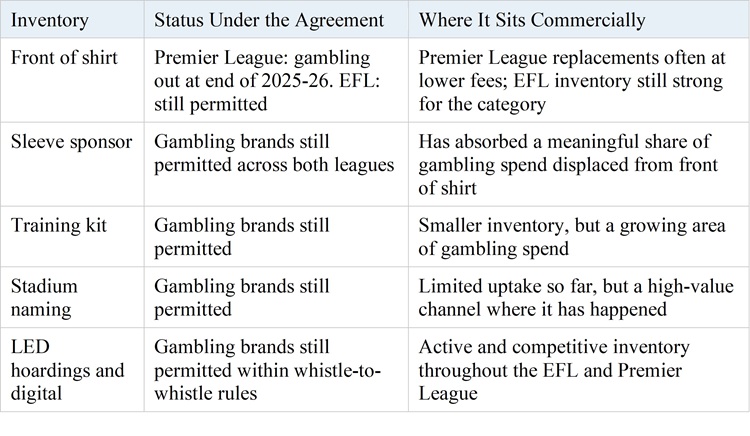
The net commercial effect on the affected clubs has been less catastrophic than the early predictions suggested. Sleeve and stadium inventory have absorbed a substantial portion of the gambling spend. Some Premier League clubs have come out broadly flat on total gambling-sector income, with the deal value shifted to different placements rather than lost altogether.
The EFL Picture Is Different
The Premier League agreement does not cover the EFL. Front-of-shirt gambling sponsorship remains permitted, common, and economically significant across the Championship, League One, and League Two.
For lower-league clubs operating on tighter margins, the gambling sector has continued to function as one of the few categories willing to pay sustainable rates for front-of-shirt placement. The EFL has been clear that any future restriction at its level would need careful thought about the financial impact on clubs already close to break-even.
The category divergence between the top-flight and the rest of the English football pyramid is one of the more interesting outcomes of the original agreement. Different leagues, different commercial calculations, different exposure to the same single category.
The Operator Side
From the operator perspective, the redistribution of football inventory has been managed rather than disruptive. The departure from front-of-shirt placement in the Premier League has been matched by increased investment in alternative football inventory, and in non-football channels.
UK-licensed casino and betting sites like Playuk.com and other operators in the category have continued to use football marketing as a core channel, with the specific placements shifting rather than the underlying spend disappearing. The displaced budget has moved to sleeve, digital, in-stadium, and lower-league inventory, with the total football-sector spend remaining substantial.
Operators with a more conservative approach to brand exposure have reduced football spend overall. Operators more committed to the channel have leaned into the alternative placements with renewed energy. The category as a whole has not retreated from football.
What the Next Two Years Will Test
The voluntary agreement runs until the end of the 2025-26 season. What happens after that is one of the more interesting open commercial questions in the sport.
Several scenarios are plausible. The voluntary agreement could be renewed indefinitely, locking the current redistribution into long-term commercial planning.
Government legislation could go further and restrict gambling marketing in other football placements. Or the agreement could lapse without renewal, letting gambling brands return to the front of Premier League shirts.
Each of those outcomes has very different implications for clubs, operators, and the wider commercial economy of English football. Commercial directors at every level of the pyramid are watching the politics carefully.
The Wider Sector Lesson
The single most useful takeaway for anyone working in football commercial is how much the agreement has revealed about the elasticity of sponsorship value across different inventory types. Front-of-shirt was assumed to be the irreplaceable headline placement.
To a degree it has been. But the speed and scale with which alternative placements have absorbed displaced gambling spend show that commercial value is more distributed across inventory types than the headline-deal framing suggests.
Sleeve sponsorship was treated as a secondary inventory for most of the past decade. It is now, in the gambling category at least, doing a substantial share of the commercial work. Stadium naming rights have similarly become more central in the conversation, even where the high-profile examples remain limited.
The next category to face this kind of voluntary restriction, whichever it turns out to be, will face the same redistribution dynamics. Commercial teams that have learnt the lesson from the gambling agreement will be better placed to manage the transition than those that have not.
What to Watch
Several things are worth tracking in the next eighteen months. Where the next Premier League front-of-shirt deals land, given the gambling departure is now confirmed. Whether any major EFL club takes the unilateral decision to drop gambling sponsorship ahead of any league-wide change.
How the operator side responds if government legislation goes further than the voluntary agreement. And whether the new commercial assumptions hold up against the actual numbers when the 2026-27 season figures arrive.
The English football sponsorship map has been moving for the past two years. The next eighteen months will show how settled the new geography actually is.