Trends Shaping The Future Of Football
How technology, live coverage and changing fan habits are redefining the world’s most popular sport.

A strange thing has happened to football over the last decade. The rules on the pitch have remained largely familiar, yet the experience surrounding the game has changed almost beyond recognition.
The ball is still round. Teams still compete for territory, create chances and try to score more goals than their opponents. Supporters still celebrate late winners and argue over refereeing decisions. But the way people discover, watch and discuss football has been transformed by streaming, smartphones, data analysis and social media.
A supporter who last followed the sport closely in 2012 would recognise the match itself immediately. What might surprise them is everything happening around it: live statistics on a second screen, tactical clips published within minutes, direct access to players, personalised alerts and global fan communities reacting in real time.
Football is no longer competing only with other sports. It is competing with every form of digital entertainment for attention. That pressure is shaping the next generation of broadcasts, club platforms and fan experiences.
Football stopped competing only with football
Years ago, a broadcaster had a relatively simple task: show the match clearly, provide commentary and offer a short studio discussion before and after the final whistle. Today, that is only the starting point.
The average supporter moves constantly between apps, messaging services, short videos, podcasts and live streams. A match may be playing on television while the same viewer checks expected-goals data, follows injury updates and shares reactions in a group chat. Every platform is fighting for the same limited resource: attention.
This has encouraged football organisations to simplify navigation, improve mobile performance and make key information available instantly. Fixtures, line-ups, live scores and highlights are now expected to appear with almost no delay. A slow or confusing platform can lose a supporter before the match has even begun.
The most effective digital products increasingly follow a simple principle: if someone wants to watch a goal, check a line-up or understand a tactical change, help them reach that information immediately.
Live football went from appointment viewing to an always-on experience
Live coverage once began shortly before kick-off and ended after the post-match interviews. Now, the event starts hours earlier and continues long after the stadium has emptied.
Supporters can follow team arrivals, warm-ups, tactical previews and live commentary before the match. During the game, they receive instant statistics and alternative camera angles. Afterwards, analysis clips, player ratings and press-conference extracts keep the conversation moving.
The growth of real-time digital content is not unique to football. Comparable design patterns appear across other live entertainment platforms, including roulette77.co.uk/live, where fast access and continuous presentation are central to the user experience.
The important point is not the category itself, but the broader expectation it illustrates is that modern audiences want immediacy. Football platforms are therefore becoming less like static websites and more like living match centres that update continuously.
The battle for attention is visible in football broadcasting
Not long ago, a football broadcast followed a predictable visual formula. There was one main camera, a few replays and a scoreboard. That approach is becoming increasingly sophisticated.
Modern productions use aerial views, pitch-side cameras, player-tracking graphics and detailed tactical overlays. Some competitions experiment with vertical highlights designed for mobile screens, while clubs produce documentary-style content that turns an ordinary week of training into an ongoing story.
Individually, many of these changes appear small. Together, they create a noticeably different relationship between the supporter and the match. The audience no longer receives only the final product; it is invited into the build-up, the analysis and the emotional aftermath.
Five trends quietly changing modern football
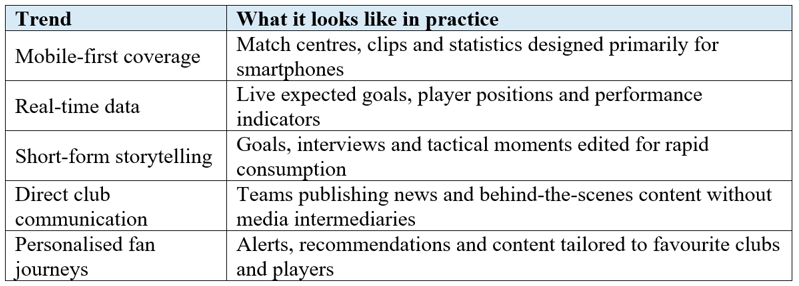
None of these trends changes the basic objective of football. What they change is how supporters experience the sport before, during and after the match.
The phone won
For years, sports reports described mobile viewing as an emerging trend. At some point, it stopped being a trend and became the default behaviour for a large part of the audience.
Football content is now frequently designed for the smallest screen first. Menus are simpler, key statistics appear higher on the page and highlights are cropped for vertical viewing. Notifications deliver line-ups, goals and final scores directly to the supporter rather than waiting for the supporter to search for them.
Older sports websites often felt as if they had been created for desktop computers and reluctantly adapted later. Newer services tend to work in the opposite direction. In some cases, the desktop version feels like the adaptation.
This shift also affects journalism. Match reports are still important, but they now compete with instant analysis, interactive graphics and short videos published while the event is still unfolding.
Data is changing how supporters understand the match
Football statistics once focused mainly on goals, shots and possession. Today, supporters encounter expected goals, pressing intensity, passing networks, progressive carries and defensive actions in almost every serious analysis.
These metrics do not replace observation, but they add context. A team may dominate possession without creating dangerous chances. A striker may fail to score while repeatedly making runs that open space for teammates. Data gives analysts a language for explaining patterns that were previously difficult to measure.
The challenge is presentation. Too much information can make a match feel like a spreadsheet. The best platforms use data selectively, showing supporters what matters without overwhelming them.
Personalisation is becoming less visible
The most effective technology often disappears into the background. Supporters rarely stop to ask why their favourite club appears first, why a relevant highlight is recommended or why a fixture alert arrives at the ideal moment.
They simply notice when those things do not happen. For this reason, personalisation is becoming more subtle. The goal is not to impress users with complicated features. It is to remove unnecessary friction and make each interaction feel natural.
This approach can strengthen loyalty, but it also creates responsibilities. Clubs and platforms must explain how personal data is used, offer meaningful privacy controls and avoid creating an experience that feels intrusive.
Clubs are becoming media companies
A major football club now produces far more than match-day information. It may operate television channels, podcasts, social accounts, documentary series, multilingual websites and direct-to-consumer membership platforms.
This changes the relationship between clubs and traditional media. Teams can communicate directly with global audiences, present players in a more personal way and build year-round narratives that extend beyond results.
The strongest club media operations understand that supporters want different types of content. Some want tactical depth. Others prefer humour, history, academy stories or access to training. A single communication style is no longer enough for a global fan base.
Women’s football is accelerating digital innovation
The rapid growth of women’s football is one of the most important developments in the sport. Expanding audiences, improved broadcasting and stronger club investment are creating new opportunities for digital storytelling.
Because many women’s competitions are building their modern media ecosystems now, they are often able to adopt mobile-first strategies without carrying the same legacy systems as older competitions. Direct player communication, social video and community-focused coverage have helped new supporters form strong connections with teams and athletes.
This growth also demonstrates that visibility matters. When matches are easy to find and stories are told consistently, audiences respond.
What the future probably will not look like
Whenever people discuss the future of football, the conversation often moves toward virtual-reality stadiums, artificial-intelligence commentators and other concepts that sound as though they belong in science fiction.
Some of those ideas may eventually find a role. But the most successful changes are likely to be less dramatic. Streams will become more reliable. Highlights will appear faster. Accessibility features will improve. Supporters will move between live video, statistics and analysis with fewer interruptions.
Football has a long history of absorbing new technology without losing its identity. Goal-line technology and video review changed officiating, but they did not change why people care about the game. The same is likely to be true of the next generation of fan tools.
The pitch will remain the centre of the experience. Technology will matter most when it helps supporters understand and enjoy what happens there.
The game stays familiar while the experience evolves
Football’s greatest strength is its simplicity. A child can understand the basic objective within minutes, while coaches and analysts can spend a lifetime studying its tactical complexity.
That balance explains why the sport can modernise without becoming unrecognisable. The match remains familiar, but the experience around it becomes faster, more informative and more personal.
If the pattern of the last decade continues, the next chapter of football will not be defined by one revolutionary invention. It will be shaped by hundreds of practical improvements: cleaner interfaces, better streams, smarter statistics, stronger accessibility and more meaningful connections between clubs and supporters.
The ball will keep moving. The stadium will keep reacting. What changes is how the rest of the world joins the conversation.