Real Madrid’s €1.2bn Revenue Tops Deloitte Football Money League
Spanish giants Real Madrid have retained the top spot in the Deloitte Football Money League, having generated close to €1.2bn during 2024/25. They are followed by FC Barcelona (€975m), Bayern Munich (€861m), Paris Saint-Germain (€837m), and Liverpool (€836m).

Launched today (21st Jan), the 29th edition of the Football Money League published by the Deloitte Sports Business Group showed the top 20 revenue generating clubs in world football generated over €12bn in revenue for the first time.
This record figure marks an 11% increase in cumulative revenues from the previous season as all three main revenue streams grew to record levels.
Commercial revenue (€5.3bn) remained the largest revenue source for Money League clubs for the third year running, accounting for 43% of total revenue in 2024/25.
This was driven by a shift in clubs’ business models focusing on the increased use of stadia and surrounding areas on non-matchdays, an increase in sponsorship revenue, and improved retail performance.
Commercial accounted for almost half (48%) of total revenue for top 10 Money League clubs, but just a third (32%) for clubs ranked 11th to 20th.
Matchday revenue remained the revenue stream that grew at the fastest rate, growing 16% year-on-year, generating €2.4bn for Money League clubs (accounting for 19% of total revenue).
Broadcast revenue grew by 10%, accounting for 38% of total revenue. This increase was primarily driven by the impact of the expanded FIFA Club World Cup – 10 Money League clubs participated in last summer’s tournament, resulting in a 17% uplift in broadcast revenues for these clubs.
Additionally, the expansion of UEFA’s three primary men’s club competitions also contributed to the clubs’ revenue growth.
Tim Bridge, lead partner in the Deloitte Sports Business Group, said: “This year’s Money League showcases the evolving commercial landscape of elite football, with clubs continuing to take greater ownership of their revenue-generating capabilities.
“It is no coincidence that the clubs in the top half of the ranking are those with the ability to focus on commercial revenue development, particularly as domestic broadcast rights plateau.
“There is a pivotal shift in some club business models with an increased focus on maximising the impact of their brand and their stadium assets. The presence of on-site breweries, hotels and restaurants is now commonplace and illustrates a strategic move to diversify income and create year-round entertainment destinations.
“This innovative approach is broadening revenue streams significantly, allowing clubs to unlock opportunities far beyond the traditional matchday experience in a drive to secure more sustainable financial futures.”
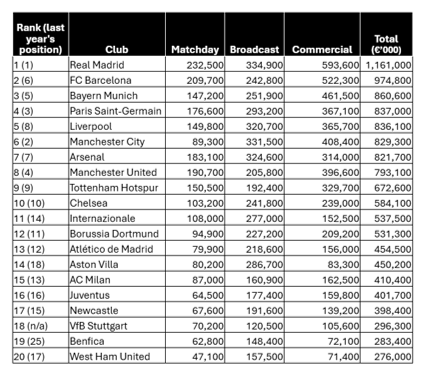
For the first time in Money League history, Liverpool emerged as the highest revenue generating English club (€836m). This surge, up to fifth in the ranking, was driven by the club’s return to the UEFA Champions League (UCL), and a 7% increase in commercial revenue following additional non-matchday events at Anfield.
Meanwhile, Manchester City (€829m) dropped four places to sixth due to a lower Premier League finish and an earlier UCL exit compared to the previous season.
Manchester United dropped from fourth to eighth in the Money League, with the club’s broadcast revenue falling from €258m to €206m largely due to a lack of Champions League football, coupled with a 15th place finish domestically.
Bridge, added: “On pitch performance remains a primary driver for clubs to progress to the upper echelons of the ranking, with many clubs benefitting from new and expanded European and international club tournaments.
“In the 2024/25 season, Money League clubs on average played more games than the season before, reflecting the growth of competitions and sporting performance of many in the ranking.
“While this presents substantial financial opportunity, a balance must be struck between revenue optimisation and protecting both the value of the on-field product and player welfare amidst ever-increasing fixture schedules.”
Image: Mario Ortiz – pexels.com
Graph: Deloitte Sport Business Group