New Playoff Mathematics: How the Third-Place Group Rule Shatters Classical Tournament Strategies at the 2026 World Cup
Fierce financial and sporting discussions surround the start of the 2026 World Cup in North America. The official expansion of the tournament to 48 national teams forces head coaches to completely revise traditional approaches to gaining points in the group stage.

The new playoff mathematics changes the game because the third-place group rule now completely reformats familiar tournament layouts. While analysts of leading clubs calculate team chances using mathematical models, ordinary fans look for a quality way to unwind, visiting Pinco casino to relieve tension after the first intense matches. The 12-group setup creates a situation in which every scored goal and every card determines the fate of a ticket to the next round.
FIFA Regulations Unveiled: The Dry Numbers of the Expanded World Cup
It is necessary to clearly understand the mechanics of progression to the next stage in the current tournament. Previously, the task for national teams was much simpler: they just needed to finish in the top two in their group of four. Now, the international federation has added an extra tournament filter, which seriously complicates life for analysts. The top two teams from each of the 12 quartets advance directly to the round of 32. However, they are joined by the 8 best third-placed teams from their respective groups. This introduction expands the knockout stage to 32 participants, doubling the number of single-elimination matches.
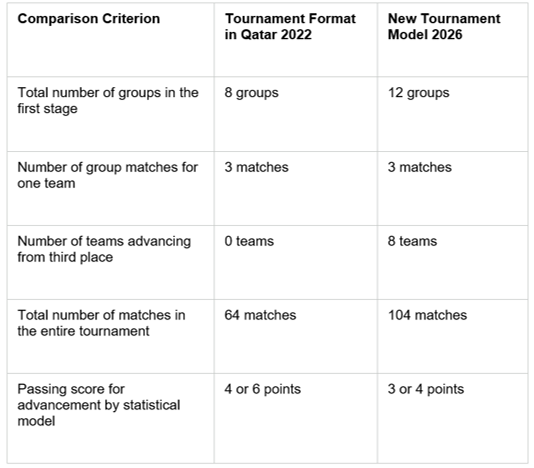
This table clearly demonstrates that the load on logistics and stadiums increases almost twofold, while the poverty threshold for advancing from the group decreases. Instead of the mandatory four points, which previously guaranteed at least some chances, national teams can now survive with just three points, provided they maintain a good goal difference. This forces managers to play highly pragmatic football from the first minutes of the opening match. Four unfortunates among the third-place finishers will go home, so the internal competition among third place intensifies to the limit.
Economics and Pragmatism: Why Managers Refuse Open Football
The new tournament model forces teams to play with extreme caution on the pitch. If previously, defeat in the first round forced a national team to open up and take risks in subsequent matches, the current strategy centers on damage minimization. Managers understand perfectly well that even a single minimal 1-0 victory in three matches under certain conditions opens the road to the round of 32. National team managers deliberately construct deep defensive blocks, abandoning high pressing, to preserve player strength for the long distance of the competition.
Football business experts highlight several key strategic changes that will define teams’ behavior on the pitch in June 2026.
– Tight control over goal difference. Even when losing 0-2 in a match, underdogs do not rush to attack in large numbers, but instead try to maintain the score to avoid worsening their chances in the indirect comparison with other groups.
– Reduction in fouls and unnecessary bookings. In cases of equal points and identical goal difference, FIFA considers the Fair Play rating, so discipline and the number of yellow cards become direct factors in success.
– Rational distribution of physical strength among team leaders. Top national team coaches make more frequent substitutions for leading performers once the match result is secured, aiming to avoid injuries before the extra round.
– Alteration of tactical setups in the decisive third round. Teams that possess 3 or 4 points in their asset play purely to maintain a draw, as this is guaranteed to be enough to get into the coveted group of the eight best third places.
Such an approach somewhat reduces the average productivity of group-stage matches, yet significantly increases the internal tension of every confrontation, where any mistake costs millions of euros in FIFA prize money.
Impact on Commercial Appeal of Final Group Stage Matches
The change in regulations significantly affects the commercial value and media ratings of the third-round matches. Previously, matches between teams that had lost their theoretical chances of the top two spots interested no one, and stadiums remained half-empty. Now, the intrigue is maintained until the final whistle of the last group, because every national team fights for the status of the best third-place team of the tournament. Television companies receive record viewership, as spectators are forced to follow parallel matches in other quarters, constantly updating tournament tables in real time.
During long breaks between these tense broadcasts, when emotions run high from calculating probabilities, many fans choose a light rest. They use the well-known service Pinco casino giriş for quick entertainment, which helps reset the mind before another wave of decisive football confrontations. Sponsors and advertisers receive a stable audience during all 39 days of the tournament, which fully justifies the massive costs of purchasing media rights.
Risks and Financial Implications for Club Football
The financial department of the international federation predicts record profits from ticket sales and commercial rights, driven by an increase in the total number of matches to 104. National federations also receive powerful financial motivation, because advancing to the first round of the playoffs brings million-dollar bonuses that can be invested in the development of youth academies locally. However, in big club business, such a long marathon is a serious challenge due to the heavy workload on leading performers. The European Club Association has already expressed concern because an additional knockout round increases the risk of severe injuries to players whose contracts cost tens of millions of euros.
Things cannot be changed mid-stream, and managers have to work with the resources available. When fierce football battles end, and analysts sit down to prepare financial reports, neutral sports fans look for quiet leisure without referee errors or tactical arguments. The reliable Pinco brand is a convenient tool for evening relaxation, offering quality table games and slots for a pleasant pastime. The current tournament in North America is only gaining momentum, but its mathematical model has already changed world football, forcing national teams to play by much more pragmatic and calculated rules, where every step is controlled by financial analysts.
Image: Fauzan Saari on Unsplash